PP · Patio Planning
Arranging Patio Furniture Around a Fixed Focal Point
How to arrange outdoor furniture around a fixed focal point: sight lines, clearance and walking routes for a patio that works after dark.
By Evening PatioPublished 1147 wordsPP-001

Place the main seating group so that every seat has a clear view of the focal point, then keep at least 36 inches (about 90 cm) of walking space behind those seats. Treat the focal point as the anchor of the layout: sight lines first, clearance second, walking routes third. Get those three right and the patio stays comfortable, legible and safe after dark.
What counts as a fixed focal point on a patio?
A fixed focal point is anything that cannot be moved without construction: a fire pit, an outdoor fireplace, a built-in grill, a fountain, a mature tree, a view through a gap in a hedge, or a lit wall. Movable items such as a planter or a side table do not anchor a layout because they can be shifted when the arrangement fails.
Once you name the anchor, the rest of the patio becomes a set of positions relative to it. This is the same logic used in manual crafts, where a numbered instruction sheet fixes the order of gestures before any material is cut: the reference point comes first, the moves follow. If you are the kind of person who likes step-by-step references, a French craft workshop such as La Table à Fiches publishes numbered sheets for manual gestures, and the principle is identical: define the anchor, then work outward.
How do sight lines decide where seats go?
Sight lines are the straight, unobstructed paths between a seated person's eyes and the focal point. For a fire pit or low table feature, the eye height of a seated adult is roughly 44 to 48 inches (110 to 120 cm) above the patio surface. For a tall fountain or a view, the line is nearly horizontal.
Draw those lines on paper before moving anything. Any object taller than the sight line that sits between a seat and the anchor will block the view: a tall planter, a heat lamp post, a serving cart, a screen. Low objects below the line, such as a coffee table or a cooler, do not block it.
A practical test: sit in each chair and look at the anchor. If you can see the flame, the water or the view without leaning, the sight line works. If you have to shift your head, the chair is in the wrong place or something is in the way.
What clearance do you need around seating?
Clearance is the distance between a seat and whatever is behind or beside it. The usual guidance for circulation behind seated diners is 36 inches (about 90 cm) so that someone can walk past without the seated person having to move. For a chair that only reclines or scoots back, 24 to 30 inches (60 to 75 cm) is often enough, but it feels tight when guests are present.
Measure from the front edge of the seat, not the back of the chair. A chair pulled out for sitting occupies more depth than the chair alone. If the patio is narrow, reduce the number of seats rather than the clearance: a three-seat arrangement that works beats a five-seat arrangement that traps people.
Around a fire pit, keep combustible materials and low-hanging fabric well away from the opening, and follow the manufacturer's stated clearances for the specific unit. Those numbers override any general rule of thumb.
How do walking routes cross a patio layout?
A walking route is the path a person takes from the door, steps or gate to the seats and back. It should not pass between a seat and the focal point, because that puts a moving body directly in someone's sight line.
Route the path behind the seating group, not through it. If the only door opens onto the middle of the patio, curve the route around one side of the arrangement and keep the center open toward the anchor. A route that is 36 inches (90 cm) wide is comfortable for one person; 48 inches (120 cm) allows two people to pass.
At night, the route matters more than the view. A guest arriving in low light needs a clear, lit path to a seat without stepping over legs, cables or planters. Keep the route free of cords, and light it with a low, shielded fixture rather than a bright one that glares into seated eyes.
Should the focal point be centered or offset?
Centering the seating group on the anchor is the simplest arrangement and the easiest to read: a symmetrical arc or a U-shape facing the fire pit, fountain or view. It works when the patio is wide enough to keep walking routes outside the arc.
Offsetting the group is better when a door, a step or a narrow edge forces the route through the space. In that case, place the anchor slightly off-center and let the seating follow it, leaving a clear lane on one side. The layout looks intentional rather than cramped.
A third option is an L-shape, which suits a corner patio or a wall-mounted feature. One arm of the L faces the anchor; the other runs along the wall. The walking route then passes behind the long arm.
How does evening light change the arrangement?
After dark, the focal point should be the brightest thing in the scene, and the seating should be lit from behind or from the side, not from the front. A light placed between a seat and the anchor will glare into the seated person's eyes and flatten the view.
Use low, shielded fixtures along the walking route and a warmer, dimmer source near the seats. If the anchor is a fire pit, the fire itself is the light; keep other fixtures low so they do not compete. If the anchor is a view or a lit wall, aim a narrow beam at it and keep the seating area in soft reflected light.
Check the arrangement at night before finalizing it. A layout that reads well in daylight can fail once the light sources are on, because glare and shadow change what the eye sees.
What is the simplest way to test a layout before committing?
Use chalk, string or cardboard templates to mark the footprint of each piece on the patio. Sit in each position at the time of day you actually use the patio, and look at the anchor. Walk the route from the door to each seat.
Adjust in this order: sight lines, then clearance, then walking routes. Moving one chair usually solves a sight line problem; moving the whole group is rarely necessary. Once the marks feel right, place the furniture and repeat the test at night with the lights on.
The goal is a patio where every seat has a reason to be where it is, and where a guest can arrive, sit and see the focal point without asking anyone to move.
Reading notes
Next on the programme
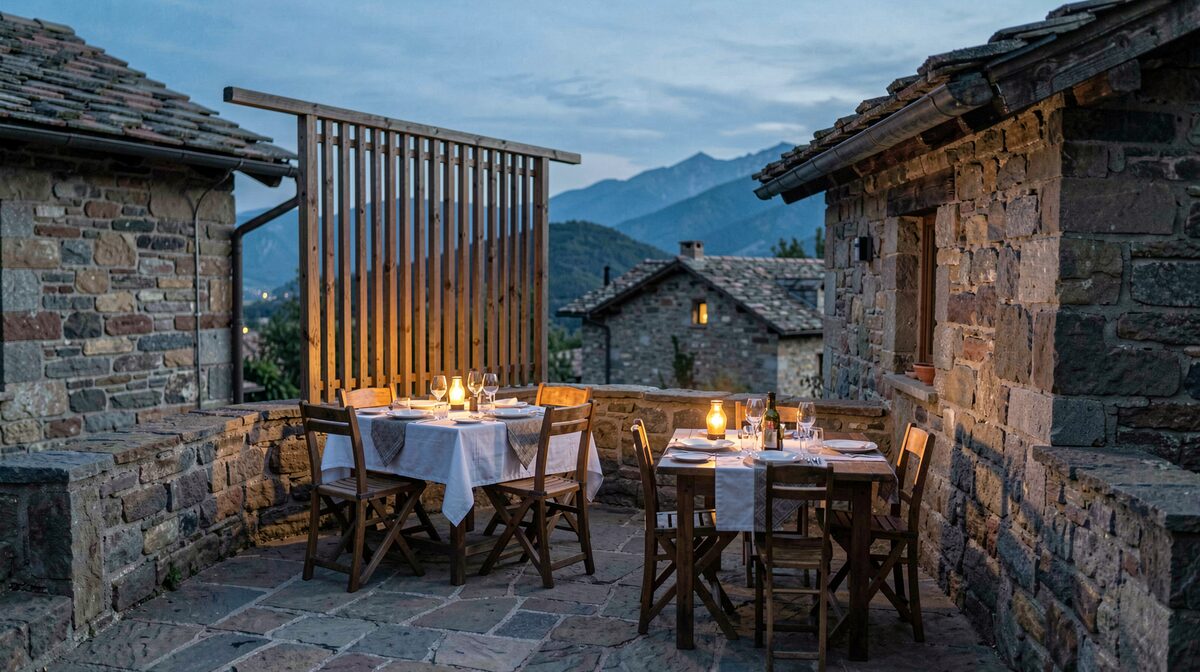 PP-003 · Patio PlanningLaying Out a Terrace for Evening Guests
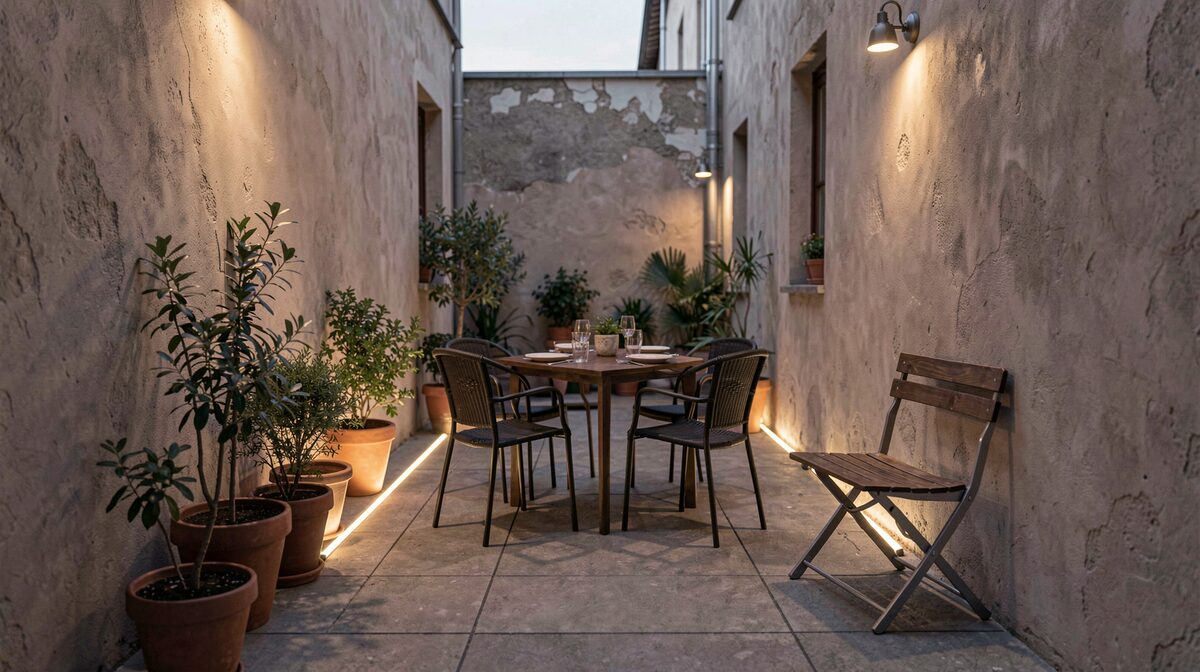 PP-002 · Patio PlanningCourtyard Terrace: Dining vs Circulation
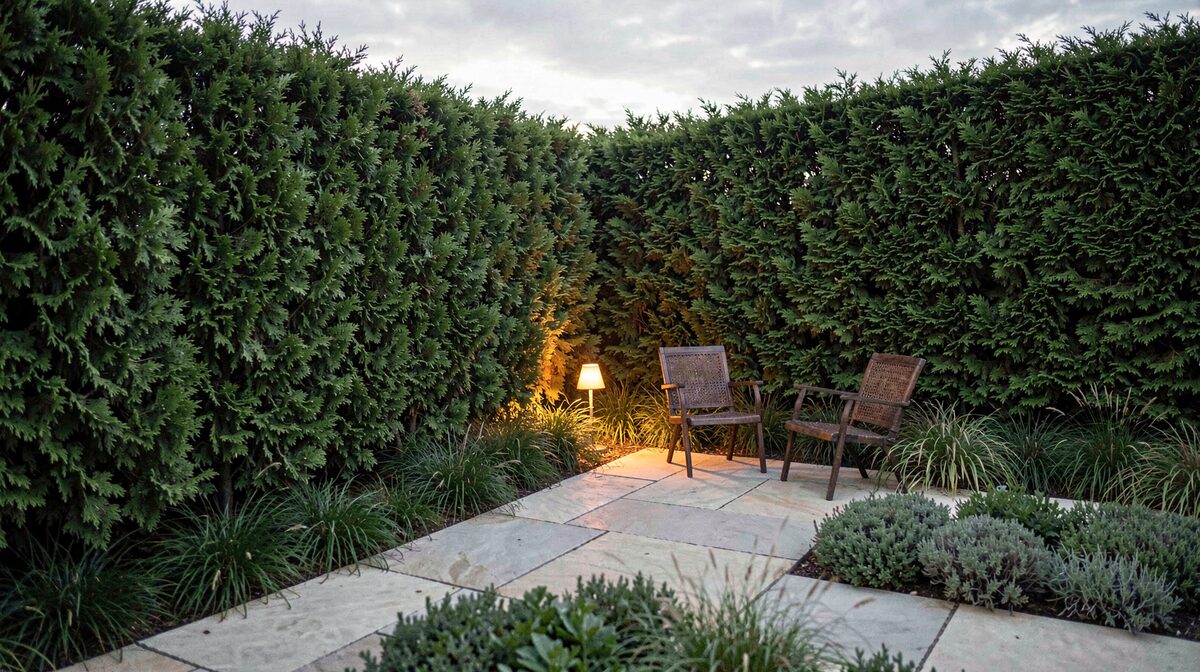 OC-003 · Outdoor ComfortLow Planting and Windbreaks on an Evening Terrace


